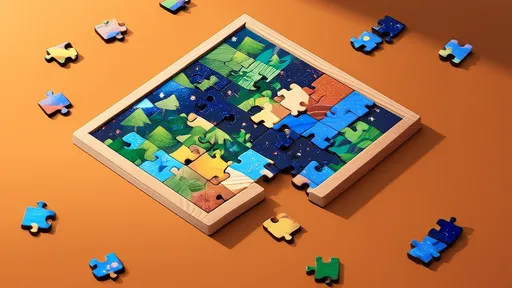
In the quiet corners of coffee shops and the focused silence of late-night living rooms, a timeless ritual unfolds. Fingers sift through scattered pieces, eyes scan for telltale patterns, and the satisfying click of interlocking cardboard signals small victories. This is the world of jigsaw puzzles, a seemingly simple pastime that has captivated minds for centuries, weaving together art, mathematics, psychology, and a profound human desire to create order from chaos.
The origins of the jigsaw puzzle are both humble and ingenious. In the 1760s, London mapmaker and engraver John Spilsbury mounted a map onto a sheet of hardwood and meticulously sawed around the borders of each country. His creation, dubbed a "dissected map," was not intended for entertainment but for education. It was a tactile tool to teach British children geography. The concept was a success, and soon other educational subjects were being "dissected." For over a century, these remained expensive, handcrafted wooden toys for the wealthy. The pivotal shift came with the advent of die-cutting technology in the late 19th and early 20th centuries. This innovation allowed manufacturers to mass-produce puzzles by stamping them out of cheaper cardboard, dramatically lowering the cost and democratizing the pastime. The term "jigsaw puzzle" itself is a bit of a misnomer, as the fretsaws used by early creators were not jigsaws, but the name stuck, evoking the intricate cutting patterns.
What is it about this activity that transcends age and era? The appeal is multifaceted, rooted in fundamental human psychology. On one level, it offers a powerful sense of agency and control. In a world often perceived as random and unpredictable, the puzzle presents a finite universe with a guaranteed solution. Every piece has its one correct place; every problem has an answer. This provides a structured escape, a manageable challenge where effort directly correlates to a visible, satisfying outcome. The act of solving engages what psychologists call a "flow state," a period of deep, immersive focus where time seems to melt away and self-consciousness disappears. The brain is fully occupied in pattern recognition, spatial reasoning, and hypothesis testing—"Does this blue swatch belong to the sky or the lake?"
Furthermore, the completion of a puzzle delivers a potent dopamine rush, a neurological reward for accomplishment. This is not unlike the satisfaction derived from solving a complex equation or finally mastering a difficult musical passage. It’s a primal reward system for problem-solving. For many, the activity also serves as a form of moving meditation. The repetitive sorting, the scanning of colors and shapes, can quiet a noisy mind, offering a respite from anxiety and the constant barrage of digital notifications. It is a rare opportunity to be fully present in a single, analog task.
At its core, solving a jigsaw puzzle is a masterclass in cognitive science. It is a rigorous exercise for the brain, engaging both the left and right hemispheres. The right brain excels at visual-spatial processing, intuiting patterns, and seeing the "big picture" or the gestalt of the image. It helps a solver recognize that a particular shade of green likely belongs to a specific tree in the scene. The left brain, analytical and logical, takes over in sorting strategies—grouping by edge pieces, color, or distinctive patterns. It systematically tests and validates hypotheses about where a piece might belong.
Successful solvers often develop and employ a range of sophisticated strategies without even realizing it. The most common is the establishment of a framework: sorting out all the edge pieces and constructing the border first. This defines the puzzle's universe and provides a critical structure. Next comes sorting by color and texture, breaking the massive problem down into smaller, more manageable sub-sections—the red of a barn, the foliage of a forest, the stippled pattern of a field. Advanced puzzlers might even sort by shape, categorizing pieces by the number and configuration of their tabs and blanks (a practice known as "knobbology"). This method relies less on the image and more on the pure form of the pieces themselves, a testament to the deeply analytical nature of the pursuit.
The role of the image on the box cannot be overstated. It is the solver's Rosetta Stone, the grand schematic that guides every decision. It provides the context that transforms abstract shapes into meaningful fragments of a whole. Without it, the puzzle becomes an exponentially more difficult endeavor of pure shape-matching, a feat reserved for only the most ardent enthusiasts. The image is the promise of what is to come, the visual goal that fuels the journey.
The social dimension of puzzling is equally fascinating. A puzzle laid out on a table becomes a communal hub, a non-digital social network. It invites collaboration. Different people bring different cognitive strengths to the table. One might excel at finding edge pieces, another at assembling a monochromatic sky, and another at intuiting complex patterns. It facilitates conversation that is not forced, flowing naturally in the spaces between concentration. It is a shared project with a low barrier to entry—anyone can find a single piece—yet it yields a collective accomplishment. In this way, puzzles can strengthen bonds between families, friends, and even strangers, creating a silent, shared language of pursuit.
The jigsaw puzzle has not merely survived the digital age; it has experienced a remarkable renaissance. In the 21st century, the market has exploded with innovation. Art lovers can now assemble puzzles featuring works from the world’s great museums. Independent artists have found a new canvas and revenue stream through licensing their intricate designs. Companies offer custom puzzles made from personal photographs, allowing people to piece together their own memories. The themes are endless: from classic landscapes and nostalgic scenes to complex, mind-bending abstract art and "mystery puzzles" where the image is not revealed on the box.
This revival can be seen as a direct response to our increasingly virtual lives. In a world of scrolling feeds and intangible digital files, the puzzle offers something profoundly physical and tangible. The weight of the cardboard, the tactile sensation of clicking two pieces together, the concrete, finished object that can be admired, glued, and hung on a wall—these provide a sensory satisfaction that pixels cannot replicate. It is a form of digital detox, a way to reclaim attention and engage in deep work. The pandemic lockdowns of the early 2020s supercharged this trend, as people sought offline activities to manage stress, pass time, and connect with household members in a shared, screen-free endeavor.
Beyond the living room, the principles of the jigsaw puzzle resonate deeply as a metaphor for problem-solving in wider contexts. Scientists, researchers, and detectives often speak of their work in terms of "fitting pieces together." They gather fragments of data, clues, or evidence—each seemingly insignificant on its own—and work to assemble them into a coherent, truthful picture. The process requires patience, the ability to hold multiple hypotheses at once, and the recognition that a piece that doesn’t seem to fit now might be the crucial key to unlocking the entire mystery later. This metaphorical power underscores the puzzle’s status as more than a game; it is a reflection of how we make sense of our world.
From its educational beginnings to its status as a modern cultural phenomenon, the jigsaw puzzle endures because it answers a deep and abiding human need. It is the quest for a perfect fit, the quiet joy of finding order, and the profound satisfaction of making a whole from many parts. It is a dance between chaos and clarity, a meditation on the relationship between the fragment and the complete image. On the table, scattered pieces slowly, inevitably, coalesce into a perfect picture. And in that process, we find a small but powerful mirror of our own endless striving to make sense of the pieces of our lives, clicking them into place one perfect fit at a time.

By /Aug 27, 2025
By /Aug 27, 2025
By /Aug 27, 2025
By /Aug 27, 2025

By /Aug 27, 2025

By /Aug 27, 2025

By /Aug 27, 2025
By /Aug 27, 2025
By /Aug 27, 2025

By /Aug 27, 2025

By /Aug 27, 2025

By /Aug 27, 2025

By /Aug 27, 2025

By /Aug 27, 2025

By /Aug 27, 2025

By /Aug 27, 2025
By /Aug 27, 2025
By /Aug 27, 2025

By /Aug 27, 2025

By /Aug 27, 2025